The Evolution of EdTech: How Online Platforms are Supporting the Remote Learner
The landscape of British higher education has undergone a seismic shift. What was once a supplementary toolset has become the very backbone of the academic journey. As we navigate through 2026, the term “EdTech” no longer merely refers to a digital repository of lecture slides; it represents a sophisticated, AI-driven ecosystem designed to mirror—and in some cases, exceed—the efficacy of the traditional classroom. For the modern remote learner in the UK, this evolution has transformed the isolation of home study into a highly connected, personalised experience.
The Digital Renaissance in UK Universities
The transition from emergency remote teaching to “Digital by Design” has been swift. According to recent data, the UK e-learning market is projected to reach a value of £5.0 billion by 2026 [1], driven by a 900% growth in the global online-learning industry since 2000. This growth is not just about the volume of users; it is about the depth of integration. Today, over 92% of universities globally have adopted comprehensive digital learning platforms that facilitate everything from synchronous seminars to asynchronous research projects [2].
In this high-pressure environment, the demands on a student’s time have never been greater. The blending of professional responsibilities with academic pursuits often leads students to seek external support to manage their workloads effectively. It is common for postgraduates to look for professional academic assistance to ensure they meet stringent university standards. When a student decides to do my assignment through a dedicated academic platform, they are often seeking to bridge the gap between complex theoretical concepts and the practical constraints of a 24/7 digital lifestyle. This trend is particularly prevalent among the 25–34 age demographic, who are the most frequent users of online courses in the UK [1].
Data-Driven Personalisation: The HEEAT Approach
True expertise in EdTech is now measured by how well a platform can adapt to an individual’s “learning DNA.” The current “HEEAT” (Helpfulness, Experience, Expertise, Authoritativeness, and Trustworthiness) standards for educational content are now being met by AI-powered adaptive learning systems. These platforms use predictive analytics to identify when a student is struggling, helping institutions identify at-risk students 28% more effectively than traditional methods [5].
- Experience & Expertise: Modern platforms like Astria Learning or Gemini for Education provide instant support; in fact, 59% of online learners now prefer AI quick-help tools over traditional FAQ systems [2].
- Trustworthiness & Authority: With the rise of digital credentials, Blockchain technology is being used to secure academic records, ensuring that a learner’s achievements are immutable and verifiable by global employers.
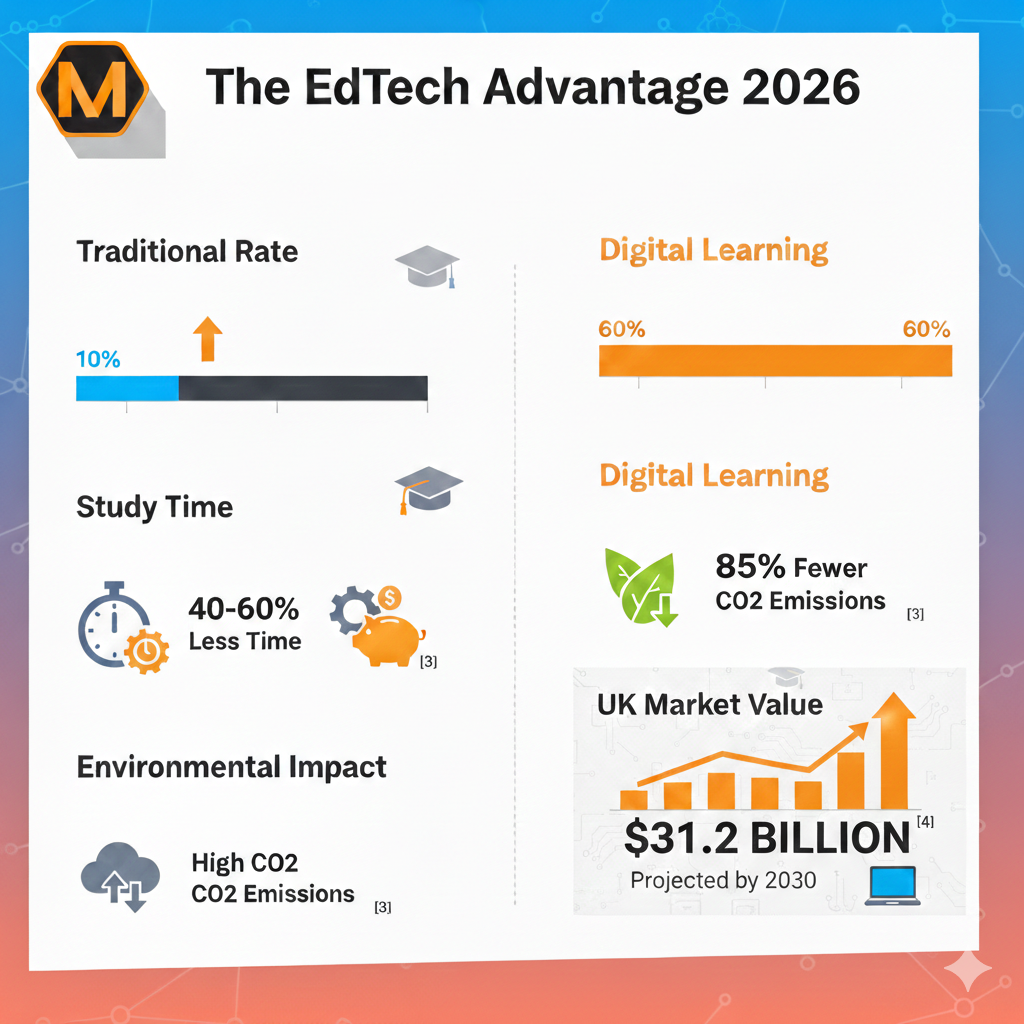
As the curriculum becomes more rigorous, the financial and academic stakes increase. This has led to a rise in students who choose to pay for assignments and expert tutoring services as a strategic investment in their final classification. By delegating specific tasks to subject matter experts, learners can focus on high-impact activities like dissertation research or industry placements, which are crucial for the UK’s competitive job market. Statistics show that e-learning can increase information retention rates to 60%, compared to just 8-10% for traditional face-to-face settings, making the strategic use of online resources a high-ROI decision for modern students [1].
See also: Exploring the Role of Technology in Mental Health Care
The Impact of Immersive Technologies
We have moved beyond the “flat” screen. In 2026, Extended Reality (XR)—which encompasses Virtual, Augmented, and Mixed Reality—is providing remote learners with “hands-on” experience from their living rooms. Medical students at universities like Manchester or Birmingham now use VR to perform virtual surgeries, while engineering students simulate structural stresses in 3D environments.
Research from Oxford College indicates that 49% of students would be more encouraged to sign up for a course if it included a VR element [1]. These immersive setups are highly efficient; a single VR lab can host a history simulation in the morning and a complex biology dissection in the afternoon without the overhead of physical materials.
“The shift from passive consumption to active, immersive participation is the hallmark of 2026 EdTech. It turns the remote learner from a spectator into a practitioner.” — Education Trends Report 2026
Infographic: The EdTech Advantage 2026
Overcoming the “Isolation Gap”
One of the primary historical criticisms of remote learning was the lack of social cohesion. Evolution in EdTech has addressed this through:
- Gamification: Adding competitive layers to learning has been shown to increase student productivity by up to 60% [3].
- Sentiment AI: Instructors now use tools that analyse the tone and engagement levels in discussion forums to gauge the “mood” of the virtual classroom, allowing for more empathetic teaching.
- Micro-credentials: The rise of “bite-sized” learning allows students to gain specific skills (like Python or Data Analytics) in short bursts. In the UK, over 1.5 million micro-credentials are expected to be awarded annually by 2027 [4].
The Future: AI as a Peer, Not Just a Tool
As we look toward the 2026 International Summit on Generative AI in Education, the UK government has committed £187 million to digital skills training [4]. This ensures that the “Digital Divide” is narrowed, providing students from disadvantaged backgrounds with the same AI-powered tutoring tools available at elite institutions. AI digital twins of real professors are already being piloted at Imperial College London, providing 24/7 on-demand guidance that adapts to a student’s unique curiosity and pace.
Frequently Asked Questions (FAQs)
Q: How does EdTech improve student grades?
A: Studies show that 81% of students believe digital technology has helped them improve their grades by providing 24/7 access to resources and immediate feedback through AI tutors [3].
Q: Is remote learning as effective as in-person?
A: Yes. A 2023 MIT study proved that students taking online courses scored as well as, or better than, in-person learners, primarily due to the ability to revisit complex material at their own pace [3].
Q: What are the main trends for 2026?
A: The top trends include AI accountability, immersive STEM simulations, and the integration of blockchain for digital degree verification.
Q: Does online learning save money?
A: Typically, students save between $50–$200 per month on transport and accommodation, while institutions save on energy consumption by up to 90% [1].
References
[1] Oxford College (2022), Online Education Statistics UK | E-Learning Data.
[2] Astria Learning (2026), Top Digital Learning Trends for Universities in 2026.
[3] Devlin Peck (2025), Online Learning Statistics: The Ultimate List.
[4] Barchart/openPR (2026), UK Government Doubles Down on AI in Education as EdTech Market Targets $31 Billion.
[5] Frontiers in Education (2025), The impact of artificial intelligence-based learning tools in academic innovation.
Author Bio
James Sterling is a Senior Academic Consultant at MyAssignmentHelp and Content Strategist specialising in the UK Higher Education sector. With over a decade of experience in EdTech integration, James focuses on how digital transformation impacts student well-being and academic achievement. He is a regular contributor to several leading educational journals in London and an advocate for accessible, AI-augmented learning environments.